If you have used a hanging style bike rack before, chances are you know the pain of trying to wiggle and jiggle your bike's frame into place. Add a few more bikes are things become hairy quickly. Platform style bike racks solve this problem by holding bicycles up by the wheels, and then hanging on by the top of the front wheel or by the frame. For years, the popular Thule 916XTR T2 was the bike rack of choice for this reason.
For 2016, Thule has updated the T2 as the
9034 T2 Pro. This rack is loaded with features that best nearly every competing rack out there, at a similar or better price point.
The new T2 Pro comes in a few different varieties. The 9034 fits 2" class 3 and larger hitch receivers, and can be used with the 9036 T2 Pro Add-On extension to carry up to 4 bicycles. The 9035 fits 1.25" hitch receivers, but it is probably heavy enough that you would not want to use it on a smaller capacity class 1 hitch. A class 2 hitch will let you carry 2 bikes. The 9036 Add-On extension won't work on the 9035 1.25" T2 Pro.

One of the biggest upgrades from previous versions is that the T2 Pro can carry up to a 5" wide fat bike wheel right out of the box with no adapters. Right now in summer 2016, this is the only full featured rack on the market that is capable of this feat. The competing Kuat NV can carry up to a 4" wide fat bike wheel when using a strap extender, but the rack wasn't designed from the ground up for fat bikes the way the T2 Pro was. Yakima's HoldUp design is really showing its age now, as it can't accept fat bikes at all. Road bikes and everything in between fit just as well as ever, as the proprietary front wheel baskets on the T2 Pro have grooves to accommodate thin wheels without any extra play or wiggle. The front wheel hooks on the T2 Pro are huge and feel very positive against front wheels of all kinds (front fenders need to be removed though).
 |
| Folded down, hatch open |
When Thule was designing the T2 Pro, they had the Kuat NV with its lightweight aluminum bike arms as the main competitor in mind. Through multiple iterations, Thule decided they couldn't make the bike rack they wanted by going with lighter weight aluminum. The T2 Pro uses heavy duty steel construction throughout, and this gives the end user several big advantages after the rack is installed. The T2 Pro has a huge lower hitch bar that places the bike rack farther away from the vehicles than all the competitors. This means the best clearance for SUVs with the hitch tucked up underneath the bumper, which is unfortunately common now. The T2 Pro has its fold down handle located at the end of the rack for easy access - no more jamming your body in between your bikes and the car to try to reach the folding handle. With the rack folded down, rear hatch access is easy and bikes sit far away. Note that this fold down mechanism won't work nicely with four bicycles, as the rack simply becomes too heavy to drop and lift nicely.
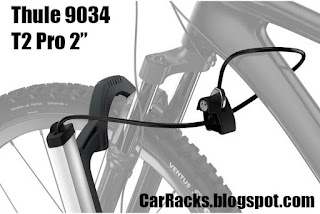 |
| Ratcheting wheel arm and locking cable |
|
Steel locking cables hide away in the bike arms of the T2 Pro. These are keyed alike to the lock on the tension handle at the bottom of the rack (which is nicely protected by a forward steel shield). It's unfortunately that Thule is still using these puny steel cables. No thief worth their salt is going to have a problem steeling bikes from this rack with anything more than a pair of scissors. This problem is by no means unique to Thule - thin, braided steel cables are the defacto standard of the rack business. The Kuat NV's hidden away steel cables feel much more substantial than Thule's tiny wires, however. Yakima's HoldUp is about on par with the T2 Pro for locks.
Pros
- Fits fat bikes right out of the box.
- Beefy steel construction places bikes far away from the vehicle and gives heaps of room between bikes.
- Super easy to load and unload bikes with ratcheting front wheel arms.
- Best folding handle access on the market.
Cons
- Very heavy. It's a shame Thule doesn't have a lightweight platform option, because that would be the no-brainer rack for most cyclists out there who don't need to haul four huge downhill bikes.
- Locking cables leave a lot to be desired. These are not stopping any motivated thief or passing ne'erdowell.
- Boring silver on grey/black finish will leave you feeling Kuat NV-ous.
I expect this rack will become the best selling bike rack across North America because of a combination of the strong Thule name and the fact that it will fit essentially every bicycle out there. It is probably overkill for a lot of people, who might be better served by the lightweight Kuat Sherpa 2.0, arriving soon. I would definitely purchase this rack myself if I needed a fat bike rack or a nice downhill hauler.


